
Most connected-product technologies solve for one moment
Fanlayer is built for what happens after that moment, across ownership changes, resale, returns, and events, without requiring a platform ecosystem, without dependency on a single application layer, and without enforcing how products are used post-sale.
We don't decide what a verified product interaction means. You do.
Fanlayer supplies the signal. The meaning is yours.
WHAT CHANGES WHEN A PRODUCT HAS IDENTITY
When a physical product carries a persistent, verifiable digital identity:
The object can be recognized as a specific unit, not just a SKU
Interaction can be referenced through the product itself
History can persist across ownership changes
Eligibility can be evaluated based on the recorded product state, depending on how licensees define their systems
THE CAPABILITY CLASSES
Each of the following becomes possible only when products carry a persistent identity. Each is licensee-defined, infrastructure-safe, and distinct.
Presence-aware products
A product can behave differently depending on where it is verified. When scanned in an approved location, brand-controlled environment, or defined venue, its identity can be referenced against that context. The product can act as a presence signal, independent of the user's account or device.
A luxury item can be referenced when returned to an authorized service environment
A collectible that responds when present at a brand flagship or pop-up
A fan product that registers its presence at a specific venue during a live event
Verified presence through the object, not the user.
Return integrity
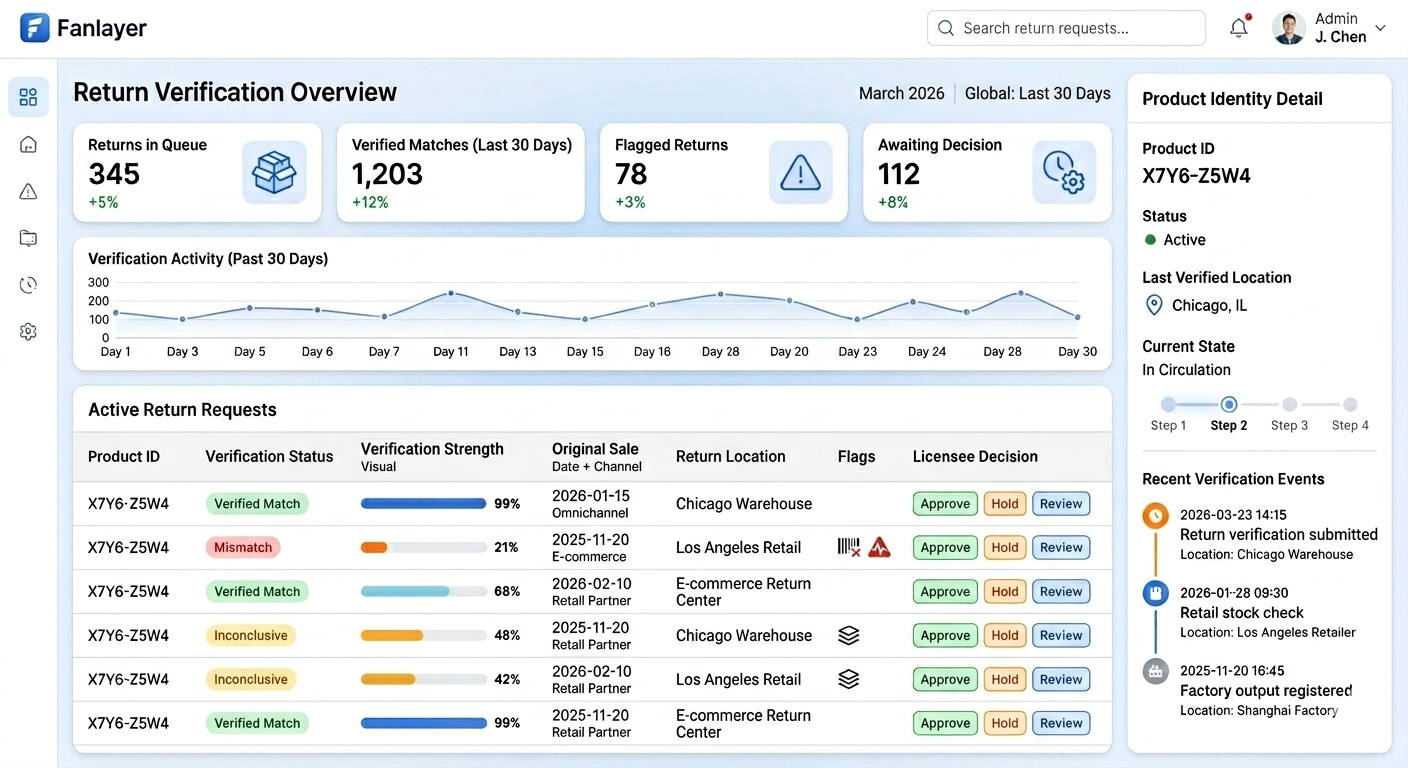
Today's return process has a blind spot. Between return initiation and inspection, brands have no reliable way to verify that the returned item is the same unit that was sold. That gap is where return fraud, counterfeit swaps, wardrobing, and misdirected refunds live.
When a product carries a persistent identity, a return can incorporate a verification step tied to the product identifier. The system enables evaluation of whether the physical item matches the original sale record before downstream decisions are made.
Unit-level return verification, not just SKU-level processing
Conditions can be flagged when a scanned identifier does not correspond to the returned item's identity or when the original sale record does not match
Chain-of-custody signals across gray-market diversion and distribution gaps
The shift: from predictive detection to record-based verification workflows
Time-aware products
A product can recognize duration, intervals, and milestones. Time can be referenced against the product itself, not inferred from account activity or purchase history.
Eligibility that acknowledges long-term ownership without account dependency
Products that respond differently after extended dormancy or re-engagement
Items that carry milestone recognition are tied to their own verified history
Time as a design dimension, deterministic, object-level.
Illustrative interface showing unit-level verification signals supporting return review and licensee decision workflows.
Use-responsive products
A product can respond to recorded interaction, not inferred or assumed usage. Systems evaluate how a specific unit has been used over time, creating interaction semantics that are deterministic and free of behavioral profiling.
Products that remain silent until meaningful verified interaction occurs
Eligibility rules based on verified scan frequency or pattern
Items that respond differently to a first interaction versus a repeated one
Deterministic interaction, without surveillance.
Event-reactive products
A product can participate during time-bounded moments. Its identity is evaluated against predefined event conditions, such as a live concert, a championship window, or a limited-release period. Products scanned during that window are treated as participants. Products verified outside it are evaluated differently.
Fan merchandise that registers its presence at a specific tour stop
Collectibles tied to championship or season windows
Limited editions that respond only during defined launch periods
Scan-time reference against defined conditions, no platform dependency.
Living provenance without enforcement
A product can carry a recorded history without restricting future use. Persistent identity allows a product to accumulate a lifecycle record, including first interactions, ownership transitions, and verified interactions, without locking the object to a single owner or enforcing resale restrictions.
Collectibles that retain verified provenance across resale and generational transfer
Luxury items that carry a heritage context independent of the original purchaser's account
Products that acknowledge prior verified moments without enforcing ownership rules
Continuity without lock-in. History without enforcement.
Thoughtful transfer and second life
When a product changes hands, through gifting, resale, or inheritance, its identity does not reset. The new holder interacts with an object that carries its full verified history. Licensees design what that continuity means.
Gifted items that remain recognized as original units long after purchase
Resale products that carry continuity signals into secondary markets
Items that preserve identity continuity without requiring the original buyer's involvement
Resale as a potential interaction point is optional for the licensee.
When a product changes hands through resale, the new owner's first scan can surface a licensee-designed activation experience. The licensee sets the price, designs the experience, and can capture value depending on implementation. Fanlayer provides the identity signal that makes the moment possible, without controlling, processing, or participating in the transaction.
The secondary market can become a designed touchpoint, not a visibility gap.
Products as interfaces, not destinations
The product doesn't become an app. It becomes a signal, one that your CRM, AI agents, and compliance tools can reference in real time. A verified scan is not an endpoint. It is the beginning of a routing decision. When a product's identity and state are referenced, that signal can be passed into CRM systems, compliance frameworks, service workflows, AI agents, or any licensee-defined downstream system. The product remains physical. It does not become an app.
CRM enrichment with verified, unit-level product presence signals
Compliance and Digital Product Passport frameworks referencing persistent unit identity
AI agents may reference product state, eligibility, and lifecycle context as part of automated decision workflows
Service and warranty routing based on verified product identity and history
Scan → state reference → eligibility signal → licensee-defined routing
Ready to explore how this applies to your category? Start the conversation → brian@fanlayer.io
How it applies across verticals
Fashion & Luxury — Verified provenance across primary and secondary markets. Repair authorization. Heritage context.
Sports — Season and championship continuity. Collectible provenance across generations.
K-Pop & Entertainment — Era-bound product identity. Tour-stop participation. Artifact continuity across ownership.
Beauty & Wellness — Batch-level reference. Refill-container continuity. Limited formulation identity.
Gaming & Collectibles — Physical assets can be linked within digital environments through unit-level identity. Verified provenance across resale.
Apparel — Garments as verified channels across purchase, resale, and post-sale engagement.
Theme Parks — Souvenirs recognized during verified interactions, connecting the physical object to the guest experience over time.
Your products have been going silent for decades. They don't have to.
We're inviting Letters of Interest from brands evaluating persistent product identity infrastructure. If that's where you're headed, let's talk.
Start the conversation →brian@fanlayer.io